Terence Chong
Product Design & Optimisation
0   /   100

Smart Scheduler

Scroll Down
Smart Scheduler

We are not machines. We live by rhythms, not scripts.

Background

Through years of personal development, I’ve realised that routine is the cornerstone of long-term success. Whether it’s mastering a skill, maintaining health, or building a career — consistency is everything. But what I also discovered is this: rigid schedules don't work in the real world - simply because we are all humans.


The Problem

Traditional planners and digital calendars often assume a fixed, linear routine. But in reality, life is fluid — time zones shift, plans get interrupted, and energy levels vary. This is especially true for people like traders, freelancers, or global collaborators.


Design Question

How might we design a personalised yet structured scheduling system that adapts to real-world complexity, rather than ignoring it?


Market Time

User Persona

I designed Smart Scheduler with my friend — a professional global trader — in mind. His lifestyle perfectly encapsulated the challenge:

・ Trades across Asia, Europe, and US markets
・ Constantly impacted by time zone differences and seasonal time shifts (DST, BST)
・ Needs to plan sleep, focus sessions, and personal time around highly dynamic market hours
・ Uses printed schedules to stay grounded and consistent each day


Primary Goals of the User

・ Automatically generate a tailored day schedule for any given date
・ Clearly visualise when global markets open and close
・ Build habits around fixed (e.g., trading), dependent (e.g., rest), and flexible (e.g., reading) activities
・ Print-friendly layout to stick on physical workspace

Design Solution

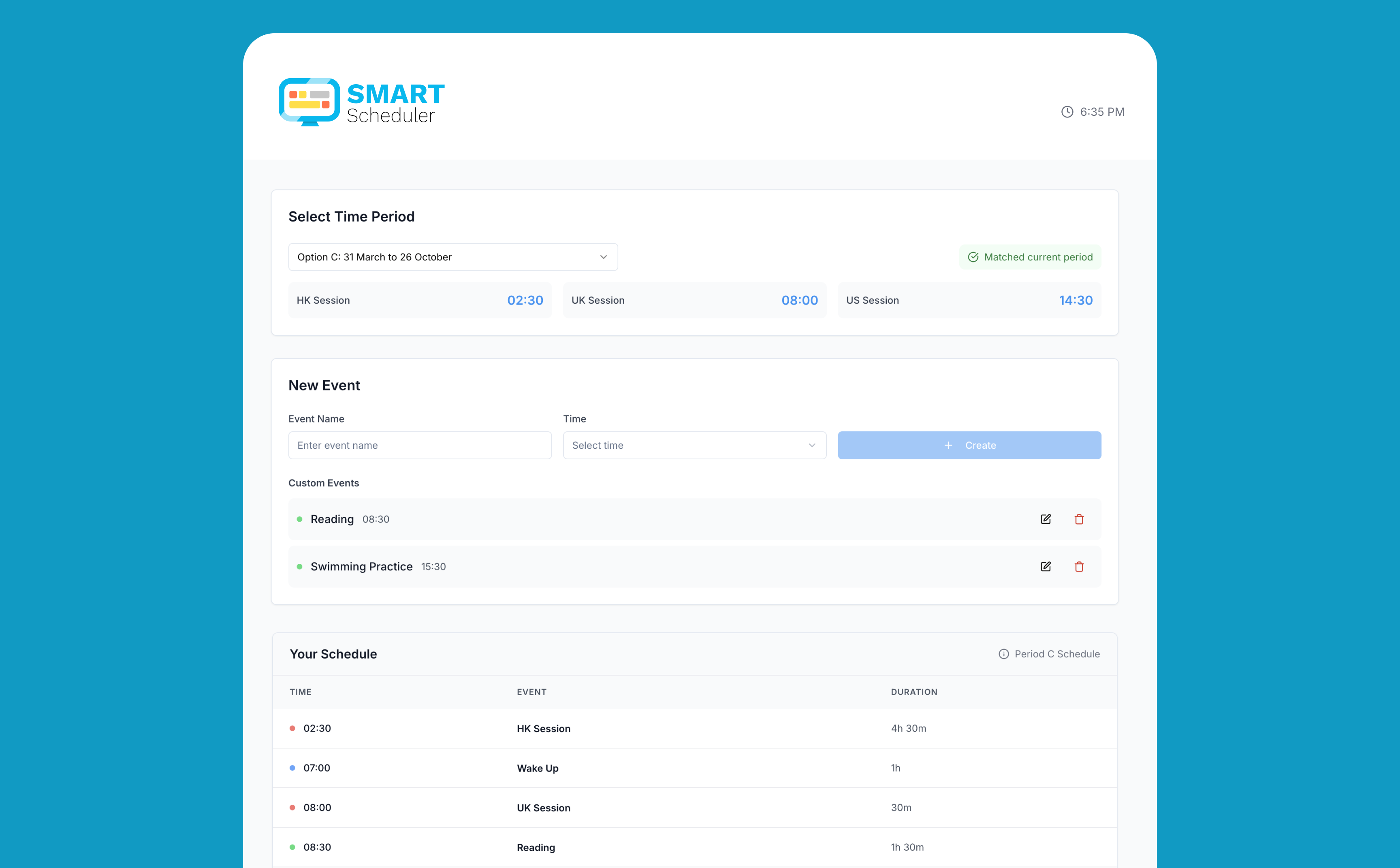
Core Concept: "Routine Grouping"

Each day starts with selecting a schedule group, which encapsulates the time-based context (e.g., "Winter — US Opens Early"). This group determines:

Fixed Activities: Unchangeable events like market open/close or school run
Dependent Activities: Adjust based on fixed timings (e.g., rest after trading, dinner after work)
Flexible Activities: Optional blocks for personal goals (e.g., drawing, reading, language practice)

This approach can be easily adapted to different scenarios. One common use case is a working parent, where there are combinations of: parent at work / on leave, and kids at school / holiday. With this grouping model, parents can easily:

・ Pre-plan their day based on school term calendar
・ Add spontaneous flexible activities like baking or relaxing walks
・ Export printouts for daily fridge-posting or family sharing
・ Well prepared for the "peak chaos" - Parent on Leave + Kid on Holiday 😂

UX Design Process

Discovery:
Problem framing, inspiration from real-life scheduling pain points

Definition:
Target persona creation, feature prioritisation

Ideation:
Concept sketches, grouping model, activity classification

Prototyping:
Low-fidelity logic modelling → Development + Build

UI Design (in progress):
Building clean, focused interface for visual clarity & print optimisation

Technology Stack

Frontend:
TypeScript, Vite, Tailwind CSS

State Management:
Lightweight React state + custom hooks

Storage:
Local memory for prototype; Drizzle ORM planned for persistent user data

Environment:
Replit (initial dev), Docker (local test), Nginx (staging)

Version Control:
Git

Final Reflection

Smart Scheduler isn’t about time management — it’s about self-management in a changing world

It’s a tool born out of empathy, shaped by real-life complexity, and designed for people who need both freedom and structure to thrive. Whether you’re a trader, parent, creator, or dream-chaser — your routine should work for you, not the other way around.

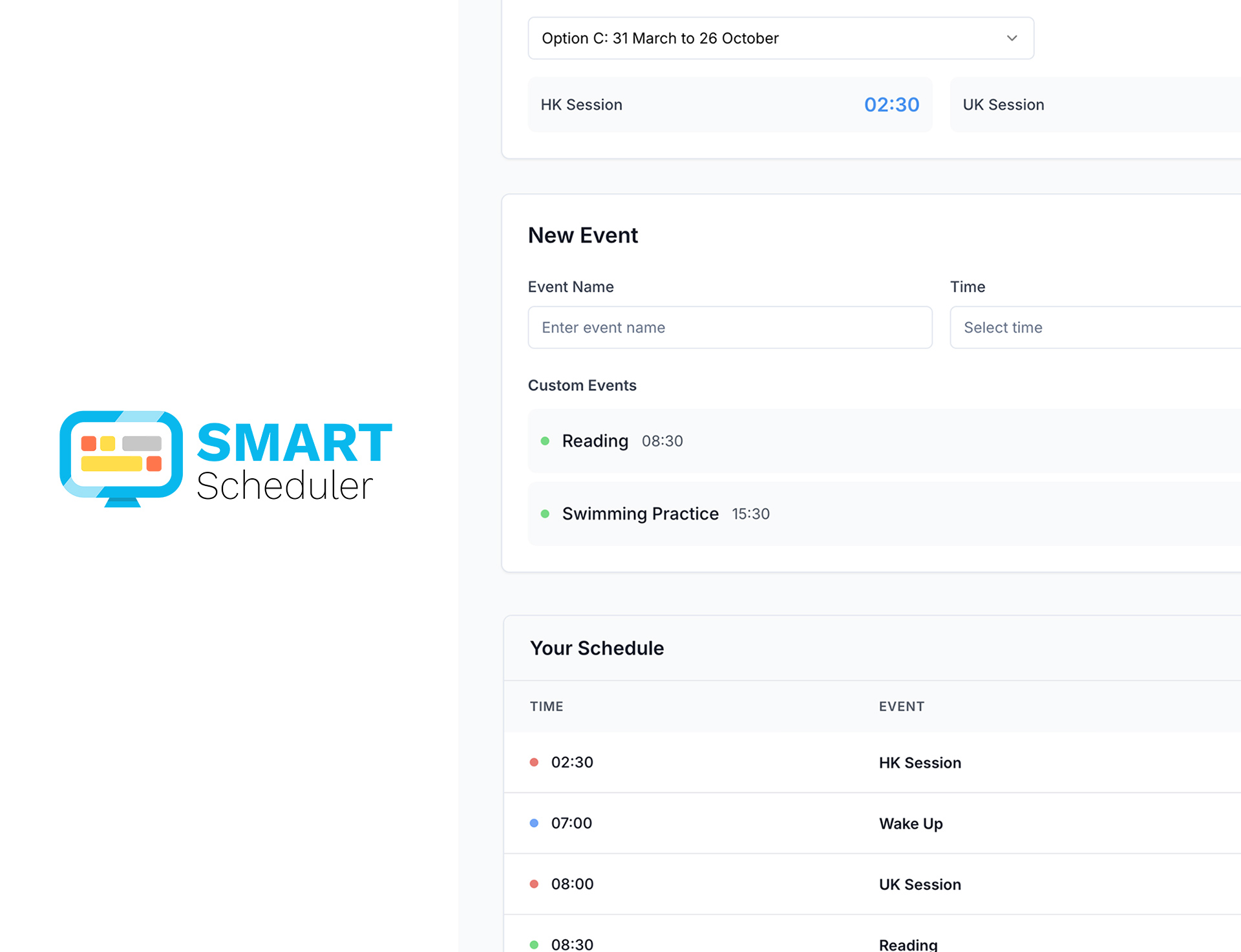
Schedule Example